The soil test that measures what rain can actually enter
A field can look loose on top and still resist water.

Ask a narrow field question
A field can look loose on top and still resist water. Another can look rough, covered with roots and residue, yet take a downpour into its pores. The difference matters for irrigation, runoff, crop establishment and the value of soil-building practices.
The USDA Natural Resources Conservation Service offers a straightforward soil infiltration test. It does not require a laboratory. It does require consistency.
The basic method uses a metal ring pressed into the soil, a known amount of water and a timer. NRCS describes a three-inch or six-inch diameter ring. For a one-inch depth of water, its guide specifies 107 milliliters for the three-inch ring or 444 milliliters for the six-inch ring. The time taken for that water to enter the soil becomes an infiltration observation.
The most important part is not the stopwatch. It is the comparison design.
Make the comparison fair
NRCS recommends representative locations and multiple measurements, ideally three or more per condition. You might compare a compacted equipment lane with a nearby undriven area, or two plots managed differently. Document the surface cover, slope, recent rainfall and initial moisture. If one location is bone-dry and another is already wet, the results will not be a fair management comparison.
The guide also cautions against testing when the surface layer is unusually dry. If needed, wet the surface and let it soak before measuring. Soil infiltration depends on the starting condition, so a single number is not a permanent label for the land.
Why do practices change infiltration? Roots and soil organisms help create channels and aggregates. Compaction can squeeze pore spaces and restrict movement. Tillage may temporarily loosen the surface but can also disturb structure. Soil type matters too: do not compare a sandy site and a clay-rich site as if management were the only difference.
For Farm Guild Connect, this makes a useful peer-learning exercise. Growers could use the same NRCS protocol on several fields, keep their raw measurements, and compare how results change with season and practice. No need to turn a small demonstration into a sweeping claim that one technique always wins.
Keep the record useful
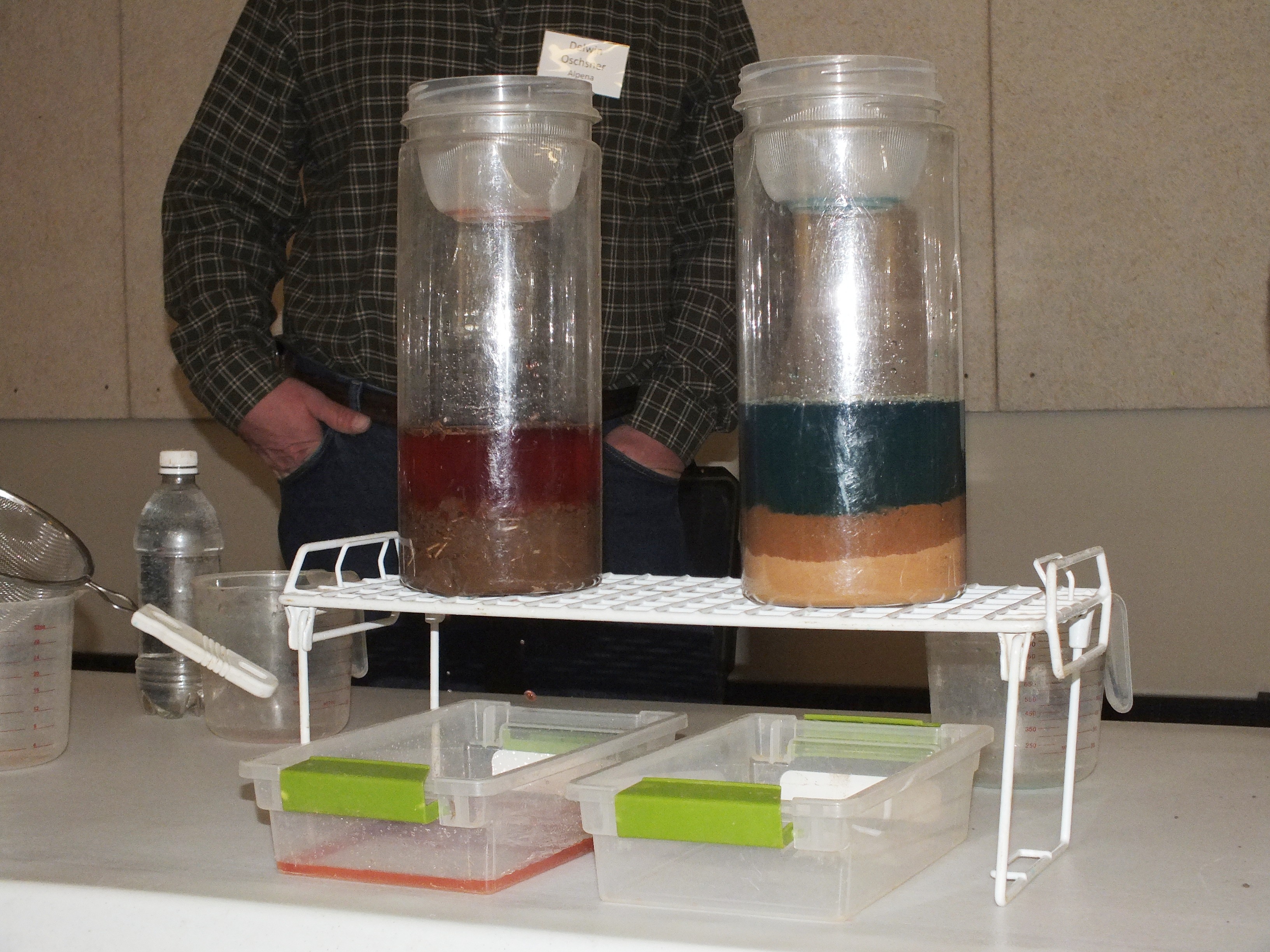
The accompanying photograph shows a USDA soil-health demonstration comparing water movement through no-till and tilled samples. It is an educational illustration, not data collected by Farm Guild members.
A good soil test answers a narrow question well: how did water enter this soil, in this place, under these conditions? Repeating that question is how a useful field record begins.
NRCS source: Soil Health, Infiltration field test guide.
Turn an observation into a usable record
Name each test location before starting and sketch it on a simple field map. Keep the raw timings alongside any calculated rate. A result without its starting moisture, ring size and surface condition is hard for another grower to interpret. If a test gives an unexpected result, write it down instead of quietly discarding it. Repeat the procedure and describe any obvious disturbance. The most valuable guild contribution may be an honest failed comparison that helps the next person avoid the same mistake. Results from a small test area should stay attached to that area rather than becoming a claim about an entire farm.
Read the original sources
www.nrcs.usda.gov — Soil%20Infiltration.pdf ↗Sources checked October 24, 2026. Time-sensitive details should be checked again before acting.
There is more to discover.